Thursday, October 28, 2010
"Sowing the Seeds of Revolution"
This blog that I am creating is focused on early American history and how the power of journalism has created and has had an overwhelming effect on what has become America as we know it today. I will be using the text by Rodger Streitmatter titled Mightier than the Sword: How the News Media have Shaped American History as the basis covering certain key milestones during the period of 1763-1776. The first chapter is called "Sowing the Seeds of the Revolution". This chapter focuses on how certain men in American History help influence the events by way of their journalistic techniques and writings. These men did definitely make the difference with their words. In 1768-1769 Sam Adams, cousin of John Adams published a series of 35 weekly articles in the New York Journal. This was today’s precursor to what we know today as the Associated Press. These articles spread the word to everyone in the colonies of the way Boston Massachusetts was being occupied by British troops; this in turn brought forth what we know today as the Boston Massacre. Another talented man who received great fame as one of the most influential journalists during the Revolutionary period was Thomas Paine. He is most famous for Common Sense. This encouraged that the American colonists should rebel against the British throne. It also said that the colonist deserved more and that they should deserve much more. In 1776 Thomas Paine joined the Continental Army. At George Washington's request to rally the troops with some positive inspiration Thomas Paine wrote The Crisis. It was published in the Pennsylvania Journal. These publications from the 1760"s and 1770"s help create a revolt against the British and force the colonists to gain an independence of there own. This independence helped form the America as we know it today.

I chose the topic because.....
The reason I chose the topic over the others was for my interest in the power that the pen had in the period from 1763 to 1776. The fact was that the early settlers of this country were only able to really believe what others had told them. Everything was based on word of mouth. We have to remember that this is a time when there wasn't any of the luxuries we have today. There were no TV's, radios, phones and definitely no computers. The thing that amazes me is the way a writer is able to write something and have it distributed to people to read with the notion that it is true. So we look back at a beginning of our history when a man named Samuel Adams shared his beliefs and the power behind his words developed to help people start the fight against the British to form America. “The land of the free”. It took many years from when he published the "Journal of Occurrences" to the time when we gained our independence. There is no doubt that the power that the men used with their published accounts made us the country we are today.
"American History from 1763-1776 and the ties that bind it to Journalism"
I will first give you a short synopsis of the historical events from 1763-1776. The British were successful in defeating the French in the French and Indian War. This ended in 1763. After the war the British now had to face the problem of being the sole major power on American soil. The two short term problems that the British faced were in dealing with the “Indian” problem and the debt they accrued in defeating the French and Indian tribes. The first problem was taken care of in a 1763 decree to keep British colonial efforts east of the Appalachian Mountains. The second problem was not so easy to contain. Over the next 13 years the British went from colonial rulers to hated colonial overlords in the eyes of the American colonists.
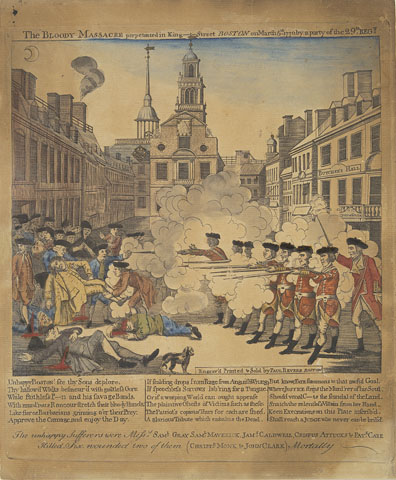
There were a series of Acts that followed over the next several years. There was British Parliament’s Navigation Act; this was the tightened regulations on sea trade and the use of the British navy and the Proclamation of 1763. In 1764 the Sugar Act had the British putting a 3 cent tax on foreign refined sugar and increased taxes on coffee, indigo, and certain kinds of wine. The taxes were raised without the consent of the colonists. This was one of the first instances in which colonists wanted a say in how much they were taxed. The Currency Act of 1764 prohibited the printing and use of colonial currency and forced that the colonists sole use of currency be that of the British. The Stamp Act of 1765 taxed all paper items and transactions which damaged the growing American newspaper industry. With all the frustration mounting from the Stamp Act, Sam Adams and Patrick Henry led the fight and creation what was known as the Sons of Liberty. This was created in 1765. There was a protest to the Stamp Act. The dissident leaders in the Stamp Act Congress of 1765 were not strong enough to force the hand of the British. While the repealed the Stamp Act in 1766 they established the Declaratory Act. This Act included a paramilitary function to administrative and enforcement structures within the colonies. This included more troops into Boston. Boston at the time was a hot spot towards the protest of the Stamp Act. The increased tension between the British troops and the colonist led to the Boston Massacre on March 5, 1770. After the Boston Massacre there was a decrease in tension in the colonies from 1771-1773. This did not mean that the protestors were not hard at work. Sam Adams and the sons of Liberty were responsible for spreading propaganda to paint a picture of a tyrannical government taking advantage of the American colonists. The Tea Act Crisis of 1773-1774 was responsible for the last stage of escalation toward American Revolution. The most famous event before the signing of the Declarations of Independence is probably the December 16, 1773, Boston Tea Party which was a protest of the taxation and enforcement of duties on tea by throwing tea in the Boston Harbor.
The British response was the Intolerable Acts which closed the Boston Harbor. The First Constitutional Congress met in 1774 and their resolution was to increase economic boycotts and stand up to the lack of representation that the British allowed the American colonists. Everything came to a head in 1775 and 1776 with the Americans and British battling in the towns of Lexington and Corcord. In 1776 the Americans declare independence. In July of that year the Americans signed the Declaration of Independence. So now that I have given you a brief history of the events of 1763-1776 I will now begin to focus on how these events came about with the influence of journalism and the journalist of this era in American history.
Outline
Journalism….”1763-1776”
How key milestones in journalism from 1763 until 1776 has helped mold the United States as we know it today.
I. Early history:
- Faces of 1763 to 1776
- 1763: Victory of British over France
II. Sam Adams
- Bio
- Journal of Occurrences 1768-1769
III. Boston Massacre 1770
IV. Thomas Paine:
- Bio
- Common Sense 1776
- The Crisis 1776
V. Conclusion of how Journalism changed 1763-1776


Faces and Images that have influenced Journalism from: 1763-1776

Photo of Sam Adams
Photo from: http://www.nndb.com/people/732/000048588/

Photo of Thomas Paine
 |
Burial site of the 5 men killed in the Boston Massacre: Samuel Gray, Samuel Maverick, James Caldwell, Crispus Attucks & Patrick Carr |
 Photo of Crispus Attucks Killed in Boston Massacre |
Photo from Wikimedia: http://upload.wikimedia.org/wikipedia/commons/c/c8/Crispus_Attucks.jpg The event began on King Street, today known as State Street, Boston on March 5, 1770 This famous depiction of the event was engraved by Paul Revere, (based on a drawing by Henry Pelham), colored by Christian Remick, and printed by Benjamin Ededs Photo from Google Images: http://llamabutchers.mu.nu/Boston%20Massacre%20Revere.jpg |
"Join or Die"
"Join or Die"

The image above was originally published in the Pennsylvania Gazette in 1751 by Benjamin Franklin. It was published during the French and Indian War. It is the best way to portray the mindset of what the colonists had to have in order to push forward and thrive. In the image the serpent is divided into eight parts, with each part representing a British American colony or region. The political cartoon was meant to depict the importance of colonial unity. During this time each colony was independant. The cartoon was recycled during the time of the American Revolution, again to stress the monumental importance of unity among the colonies if they had any hope of defeating the British along with gaining freedom. The cartoon was a symbol of democracy and freedom during the war. By 1774 the segments of the snake had grown together, and the motto had been changed to read: "United Now Alive and Free Firm on this Basis Liberty Shall Stand and Thus Supported Ever Bless Our Land Till Time Becomes Eternity"
Photo from: http://possumblog.mu.nu/images/join_or_die.jpg

Subscribe to:
Posts (Atom)