So up until this point my blog has been focused on several men and the era leading up to the signing of the Declaration of Independence. In this period, we had men like Samuel Adams and Thomas Paine with there journalistic wisdom help shape America America United States of America
Sunday, December 5, 2010

Why I decided on Watergate
The reason I chose Chapter 13 Watergate was basically because it was one of the first chapters in this book that I was around for. Yes it’s true but I was a young child at the time. I do remember hearing Nixon’s resignation on the television. But really had no clue what was going on. I remember my parent’s faces clued to the TV and being told to be quiet. Today, I understand the significance of the speech and why it was the big news story that it was. I really find it fascinating that a front page story in a newspaper can uncover one of the biggest political corruption scandals to date. I do wonder though what was going through a man like President Nixon’s head at the time of this scandal. Did he really think he was going to get away with this? Imagine if the burglars were never caught what other damage could he have created. I really enjoy researching and reading about the background of this story and how 2 journalists started with a break-in story can lead to the resignation of the leaders of a powerhouse nation like the United States of America.
Watergate Summary: The Biggest Political Corruption Scandal in American History
The year is 1972. The man in charge of our country is a man named Richard Milhous Nixon. The events that unfold over the next 2 years will go down as a first in American History. The end result is the President of the United States of America United States

The events all started on June 17th, 1972 in our nation capital. The Washington Police caught 5 men in suits wearing surgical gloves at the Democratic National Committee offices at the Watergate office complex. These men were caught trying to place listening devices in the offices. The supplies that the burglars were caught with included: lock picks, $2300.00 in cash all in $100 bills, walkie talkies, a device to listen to police calls, film, 2 cameras and tear gas guns. To me, smells like trouble. The Washington Post, the leading newspaper in Washington
 The now famous reporters had done everything they could to get evidence to back there story on the Watergate scandal. They begged, knocked on endless doors, pleaded, and even lied to get the information they needed to verify there stories. They didn’t rely on a whistleblower but they would get the biggest break in the scandal which would be dubbed “Deep Throat”. This was a reference to a popular pornographic movie at the time. It wasn’t until 2005 that the source behind the name was revealed. The person behind the infamous name was none other then the #2 man at the head of the FBI at the time, W. Mark Felt. He had verified many of the facts at the time of the scandal. All of these this had to be verified before Woodstein had reported them in the Post. Basically, the Washington Post had run with the stories of the Watergate scandal alone.

A lot of the other newspapers, television stations, news agencies accused the Post of overplaying the story. The Post pretty much had been alone. Even the top dogs, The New York Times, the AP and UPI hadn’t reported on the scandal. After months of the investigation after the burglaries the White House stood its ground. They admitted nothing, downplayed everything. Nixon aides cut off access to administration sources and threatened to cancel the licenses of 2 Florida TV stations the Post had owned. The abuse of power to starting to be evident, The attacks by the Post intensified they reported that the White House Chief of Staff, Haldeman had participated in the political corruption, Nixon’s target continued to be the TV stations in Florida. According to Oval Office tape recordings the president instructed aides to have political supporters in Jacksonville and Miami

Although the Washington Post deserves most of the credit, the Fourth Estate alone didn’t expose the Watergate scandal. The corruption was of such monumental proportions that it took all arms of the government to expose the President and all his cohorts. The judicial branch entered when they indicted the 5 burglars and there 2 bosses. E. Howard hunt and G. Gordon Liddy. In January 1973, Judge Sirica announced he wasn’t satisfied with the 7 indictments and that they didn’t tell the complete story. One of the burglars James McCord then broke his silence in exchange for a lighter sentence. His testimony confirmed most of the reporting of Woodstein. A federal grand jury then indicted 3 of Nixon’s closest aides, John Mitchell, Haldeman and John Ehrlichman. Sirica demanded to listen to Nixon’s secret Oval Office tape recordings. The legislative branch voted to establish a committee to investigate charges of corruption in the 1972 Presidential election. The legislative branch brought everything to a climax when the House of Representatives Judiciary Committee voted 3 articles of impeachment in July 1974, charging President Nixon of obstruction of justice, abuse of power and contempt of Congress for defying committee subpoenas. In May 1973 Attorney General Richardson appointed Archibald Cox to investigate Watergate. Judge Sirica wanted to hear the White House tapes, Nixon refused to release them. An appeals court ruled in Sirica favor and Cox said that he would continue to seek the tapes from the White House. Nixon told Richardson Richardson 
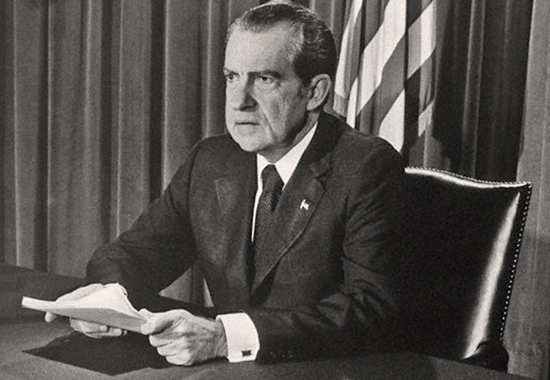
So before the impeachment process could be completed on August 9th 1974 President Richard Milhous Nixon resigned from office. To this day he is the only President to resign. So as we can see from the results of one man’s reporting on a story in the nations capital we have uncovered how the power of the press works.
Friday, December 3, 2010
Everything you want to know about Watergate by: The Washington Post
Research the entire Watergate scandal in this 4 part series by the Washington Post
Link, Photos and Videos are at
This is how it all started..........
It all started with a reporter named Bob Woodard. Today, he is regarded as one of the greatest investigative reporters of all time, the cream of the crop, an all-star, a legend. Every journalist knows who he is. Every journalist I would imagine would want to be like him. I know I would. He was hired by The Washington Post in 1971 as a reporter. So here is the scenario, June 17, 1972, the phone rings the in the middle of the night, barely awake he learns five men have broken into the Watergate Hotel complex at the Democratic National headquarters in Washington D.C. Here are the actual notes he wrote in his notebook.


The Washington Post and Watergate
Another site I found with information on the Washington Post and Watergate:

President Richard Nixon -" The Resignation"
It all started with a front page story in the Washington Post about a burglary. It ended with the resignation of the President of the United States of America. A first in United States history. Listen to the video of President Nixon's resignation below:
Video from: http://www.youtube.com/watch?v=ZEOGJJ7UKFM

Woodward and Bernstein: Lighting the Fire - Parts 1 and 2
Watch these two very informative video on the 2 men that were very instrumental in changing American History
Link to Part 1:http://www.youtube.com/watch?v=Cl0eb5TaPgs
Time magazine article on "DeepThroat"
The confidential source of Woodward and Bernstein was nicknamed “Deep Throat" He was a friend of Woodward they had meet before Watergate. He was anonymous until 2005 when close to death and revealed to be William Mark Felt Sr; #2 in command of the FBI at the time of Watergate. He was a trusted and an official of the Executive Branch in the government. The way Woodward met with "Deep Throat" was very clever. Remember he stayed anonymous. Woodward would send a signal to him by moving a flower pot with a red flag in it to the rear of his apartment balcony; then the two would meet about 2 a.m. in an underground garage. If Deep Throat wanted to set up a meeting, he would send a message to Woodward's through his morning copy of the New York Times; on the lower corner of page 20, clock hands would be drawn to indicate the time of the rendezvous. Woodward never figured out how "Deep Throat" got hold of his newspaper. "Deep Throat" had great connections be he didn’t want to send Woodward any new information. His main focus was to back up the information that Woodward had and keep him away from false leads.
Read more: http://www.time.com/time/magazine/article/0,9171,943626,00.html
Read more: http://www.time.com/time/magazine/article/0,9171,943626,00.html
Photo of Washington Post journalists at work during Watergate
Woodward and Bernstein meeting with the Washington Post's Publisher
Katharine Graham, Managing Editor Howard Simons and Executive Editor
Ben Bradlee.
Katharine Graham, Managing Editor Howard Simons and Executive Editor
Ben Bradlee.
Project 3 Wrap-up
As you can see, the events that unfolded from the Washington Post's story on the break-in at the Watergate office complex to the resignation of President Nixon changed American History. At the time of the initial story on one really knew the magnitude that this story would create. Again, I want to mention that I enjoyed reading and researching the information in this era basically because it was a story that evolved when I was a young boy. I would like to mention that the political corruption that was revealed really shed a negative light on President Nixon even though he was instrumental in the ending of the Vietnam War and was famous for his positive effect on the relations that developed with China.
Friday, November 19, 2010
Who was Father Coughlin?? A Brief History:
Charles Coughlin was born on October 25, 1891, in Hamilton, Ontario, Canada to Irish-Catholic parents. He grew up under strict Catholic rule. Coughlin graduated from the University of Toronto in 1911. He then attended St. Basil's Seminary in Toronto, there he grew fond of the idea of priesthood as a teen he was then ordained as a Catholic priest in 1916. Father Coughlin taught for seven years at the Assumption College in Windsor, Ontario, and made his move to the States in 1923, by way of Detroit, Michigan.
Father Coughlin first broadcast was in 1926, broadcasting weekly sermons over the radio. By the early 1930s the content of his broadcasts had shifted from religion to economics and politics. Most of the nation was focused on matters of economics and politics being that the country was in the aftermath of the Great Depression, so was Father Coughlin. At first, he was a supporter of President Franklin Delano Roosevelt. Father Coughlin had a very well-developed theory that he phrased “social justice," predicated on monetary reforms. Father Coughlin considered President Roosevelt a reformer like himself. Roosevelt's approach during his inaugural address totally promised to "drive the money changers from the temple." Coughlin's was in total agreement since a big part of his own message was monetary reform. Roosevelt's early monetary policy seemed to fulfill this promise and so Coughlin viewed him as the savior of the nation. Later in the 1930s his focus shifted against President Roosevelt and he then became one of his ruthless critics. His program of "social justice" was a very radical challenge to capitalism and too many of the political institutions of his day. When President Roosevelt failed to follow-on with additional radical reforms, Coughlin turned against him. By 1936, he would support a third-party candidacy called the Union Party. This party did not last very long. It was against President Roosevelt. He had some harsh words for the President he said:
"The great betrayer and liar, Franklin D. Roosevelt, who promised to drive the money changers from the temple, had succeeded [only] in driving the farmers from their homesteads and the citizens from their homes in the cities. . . I ask you to purge the man who claims to be a Democrat, from the Democratic Party, and I mean Franklin Double-Crossing Roosevelt."
Father Coughlin's influence on America Depression-era America was massive. Millions of Americans listened to his weekly radio broadcast. At the height of his popularity, one-third of the nation was tuned into his weekly broadcasts. In the early 1930s, Coughlin was, questionably one of the most influential men in America. Although his core message was one of economic populism, his sermons also included attacks on well-known Jewish figures. These attacks that many people considered evidence of anti-Semitism. His broadcasts became increasingly controversial. In 1940 much to his dismay his superiors in the Catholic Church forced him to stop his broadcasts and return to his work as a parish priest.
Father Coughlin first broadcast was in 1926, broadcasting weekly sermons over the radio. By the early 1930s the content of his broadcasts had shifted from religion to economics and politics. Most of the nation was focused on matters of economics and politics being that the country was in the aftermath of the Great Depression, so was Father Coughlin. At first, he was a supporter of President Franklin Delano Roosevelt. Father Coughlin had a very well-developed theory that he phrased “social justice," predicated on monetary reforms. Father Coughlin considered President Roosevelt a reformer like himself. Roosevelt's approach during his inaugural address totally promised to "drive the money changers from the temple." Coughlin's was in total agreement since a big part of his own message was monetary reform. Roosevelt's early monetary policy seemed to fulfill this promise and so Coughlin viewed him as the savior of the nation. Later in the 1930s his focus shifted against President Roosevelt and he then became one of his ruthless critics. His program of "social justice" was a very radical challenge to capitalism and too many of the political institutions of his day. When President Roosevelt failed to follow-on with additional radical reforms, Coughlin turned against him. By 1936, he would support a third-party candidacy called the Union Party. This party did not last very long. It was against President Roosevelt. He had some harsh words for the President he said:
"The great betrayer and liar, Franklin D. Roosevelt, who promised to drive the money changers from the temple, had succeeded [only] in driving the farmers from their homesteads and the citizens from their homes in the cities. . . I ask you to purge the man who claims to be a Democrat, from the Democratic Party, and I mean Franklin Double-Crossing Roosevelt."
Father Coughlin's influence on America Depression-era America was massive. Millions of Americans listened to his weekly radio broadcast. At the height of his popularity, one-third of the nation was tuned into his weekly broadcasts. In the early 1930s, Coughlin was, questionably one of the most influential men in America. Although his core message was one of economic populism, his sermons also included attacks on well-known Jewish figures. These attacks that many people considered evidence of anti-Semitism. His broadcasts became increasingly controversial. In 1940 much to his dismay his superiors in the Catholic Church forced him to stop his broadcasts and return to his work as a parish priest.
My personal thoughts and why I chose the chapter on Father Coughlin
I chose Chapter 8, Father Coughlin, in Mightier than the Sword. One of the main reasons I chose this chapter is because I find it baffling as to why person can be so ignorant and close-minded in our world. The thing that really interested me in my research and reading through my blog was that I really didn't find any significant reason to one question….Why?? Why did this man go from a boy being raised in a Catholic home to a priest in the Catholic Church to spewing so much hate and anger? Did something in his upbringing spark this change in personality? Another reason I chose this chapter is because I find it fascinating that one man can have so much power and influence with his words and writings to have people become followers. There is a small part of me that is envious of the man. Don’t get me wrong in no way shape or form am I a bigot. The reason I am envious is because there is a part of me that wishes I could have the power that he had. The only difference I would have would be that I could spread positive and use it to help the people of this world. I hope the information I have gathered for you in this second project is useful. It has really opened up my eyes.
The Different Sides of Father Coughlin
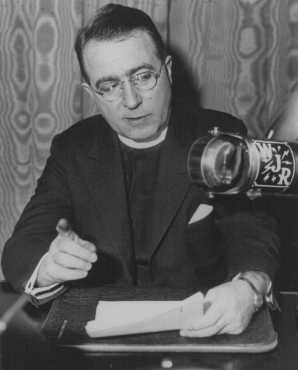
Throughout this second blog project which is focused the way journalism has influenced history I will show the different sides of Father Coughlin. From the year he was born, 1891 until about 1934 Father Coughlin was viewed as being more a positive than negative. He was very strong about his Catholic faith. Father Coughlin was ordained to the priesthood in 1916. In my opinion from 1916 until 1923 when he taught at the Assumption College in Windsor Ontario he did a great service and gave to others. He then moved to Royal Oak, Michigan’s National Shrine in the Little Flower. In 1926 he began radio broadcasts on station WJR. This was in response to the cross burnings by the Ku Klux Klan on the grounds of the church, At that time he gave a weekly hour long radio program. In 1931 the CBS radio network dropped free sponsorship after Coughlin refused to accept network demands. CBS wanted his scripts to be reviewed prior to broadcast. At that time he raised enough money to create his own national network. Father Coughlin was then able to reached millions of listeners.
Images of Father Coughlin....."From a Child to Hater"

Father Coughlin as a Child
Image from: http://info.detnews.com/dn/history/coughlin/images/coughboy.gif
Image from: http://info.detnews.com/dn/history/coughlin/images/coughboy.gif

Subscribe to:
Posts (Atom)